A Game of Living Worlds
A cooperative board game where you play a Spirit of Nature — each one a real, scientifically studied phenomenon — growing a biodiverse, interconnected world across a century of climate, and defending it against everything that century brings.
Not a theme painted over an engine. Biodiversity literally is resilience; connection literally is strength; a keystone species literally holds up its web. Where the popular version of a story is overstated, the card says so — and those honesty flags are a feature, not an apology.
Abilities reference functions — Pollinator, Keystone, Nitrogen-Fixer — not card names. Ecologists group species by what they do, and substitutable species make a deck that scales.
Every card declares what feeds it and what it feeds. Actions resolve bottom-up the chain, so the resolution order teaches the structure.
A scarce set of obligate pairs — otter and kelp, acacia and ant. While both live, neither can be broken. Split them and both are exposed.
A slow, near-hopeless opening. A middle where collapse feels certain. Then a late game where matured ecosystems and interlocking Spirit powers detonate together and clear the goal by a hair — a win that should feel planned, not lucky.
Full data model — biome, climate, points, cost, trophic role, keywords, bonds. Every one renders from its record.
Biodiversity, Connection and hazard mitigation compute live, and show their arithmetic.
Five findings, two of them blocking. See Does it work? — the game is not yet playable end to end.
Everything needed to actually play, from setup to the final scoring. Numbers here are the current design values — they are meant to be playtested and moved.
The two engines that carry the game, both computed live rather than asserted: the terraform cascade that turns a desert into forest, and the ecology scoring that makes a keystone species worth far more than its own points.
Biome is never chosen — it is read from Water × Warmth. Raise a hex to Elevation 4 and it becomes a Mountain: the windward side gains water, the leeward side loses it, and every changed hex is re-read on the table. Click a hex to raise or lower it.
Six cards forming a complete web. Toggle the Sea Otter out and watch what a 3-point card is really worth.
The kelp cannot hold without a keystone predator — the same rule real urchin barrens follow.
Rewards distinct function, not distinct species.
What each card contributes, plus bonds that are actually intact.
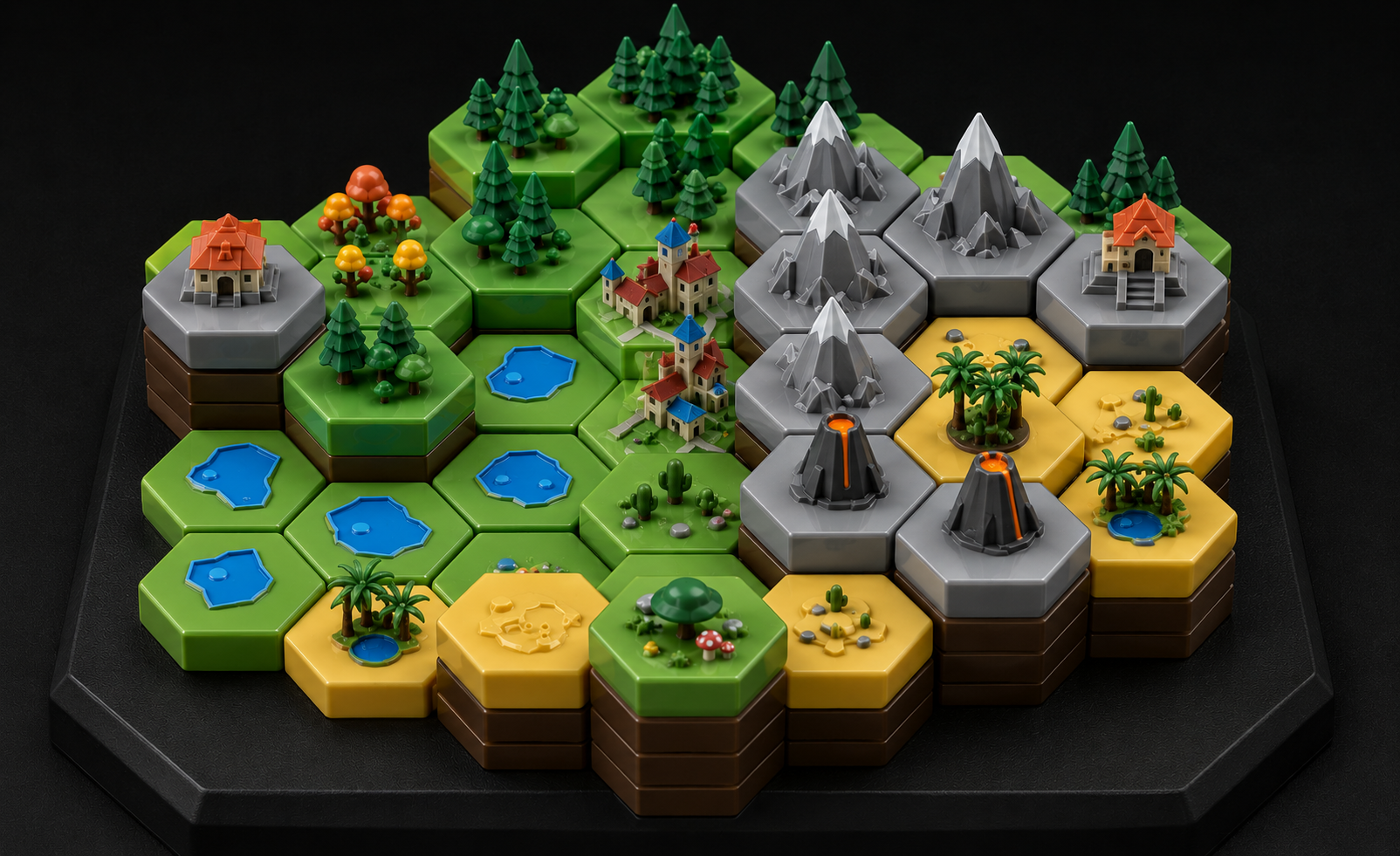
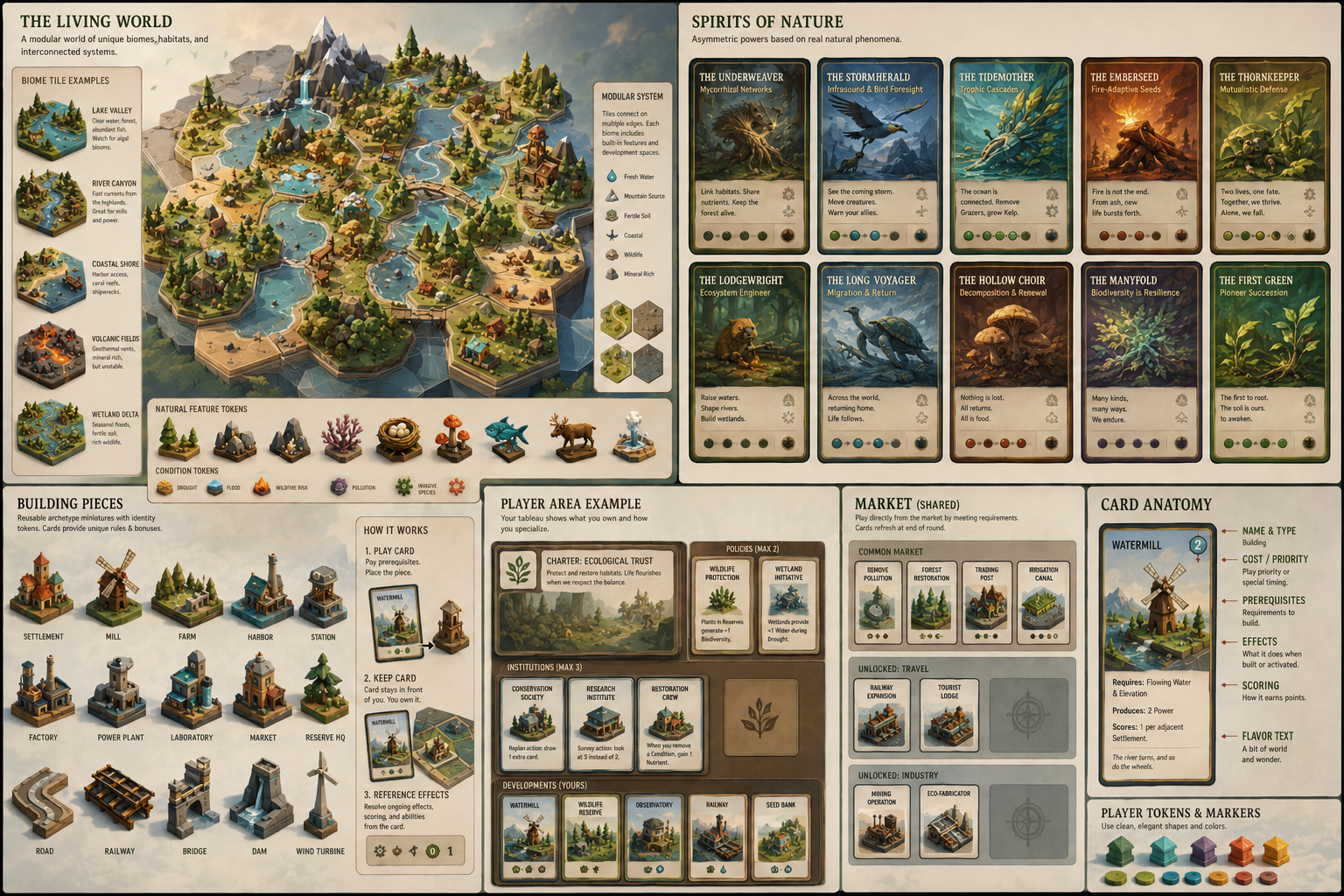
The source images this design is being built toward. Click any board to open it full size. Read together they define the look — and one of them describes a game meaningfully different from the rules as currently written, which is called out below.
Low-poly stacked hexes with snap-on sculpts, elevation reading as literal layers of soil beneath each tile. This validates the protected element directly: elevation is not an abstraction here, it is the toy. Volcanoes, peaks, lakes, oases, settlements — all snap-on, all readable across a table.
The modular hex world, ten Spirit cards with finished art, the full set of building archetypes, and a worked player-area example.
This one is not just art direction. It specifies core systems, actions, turn structure, player components, victory conditions and card anatomy — and several of them contradict the rules as currently written.
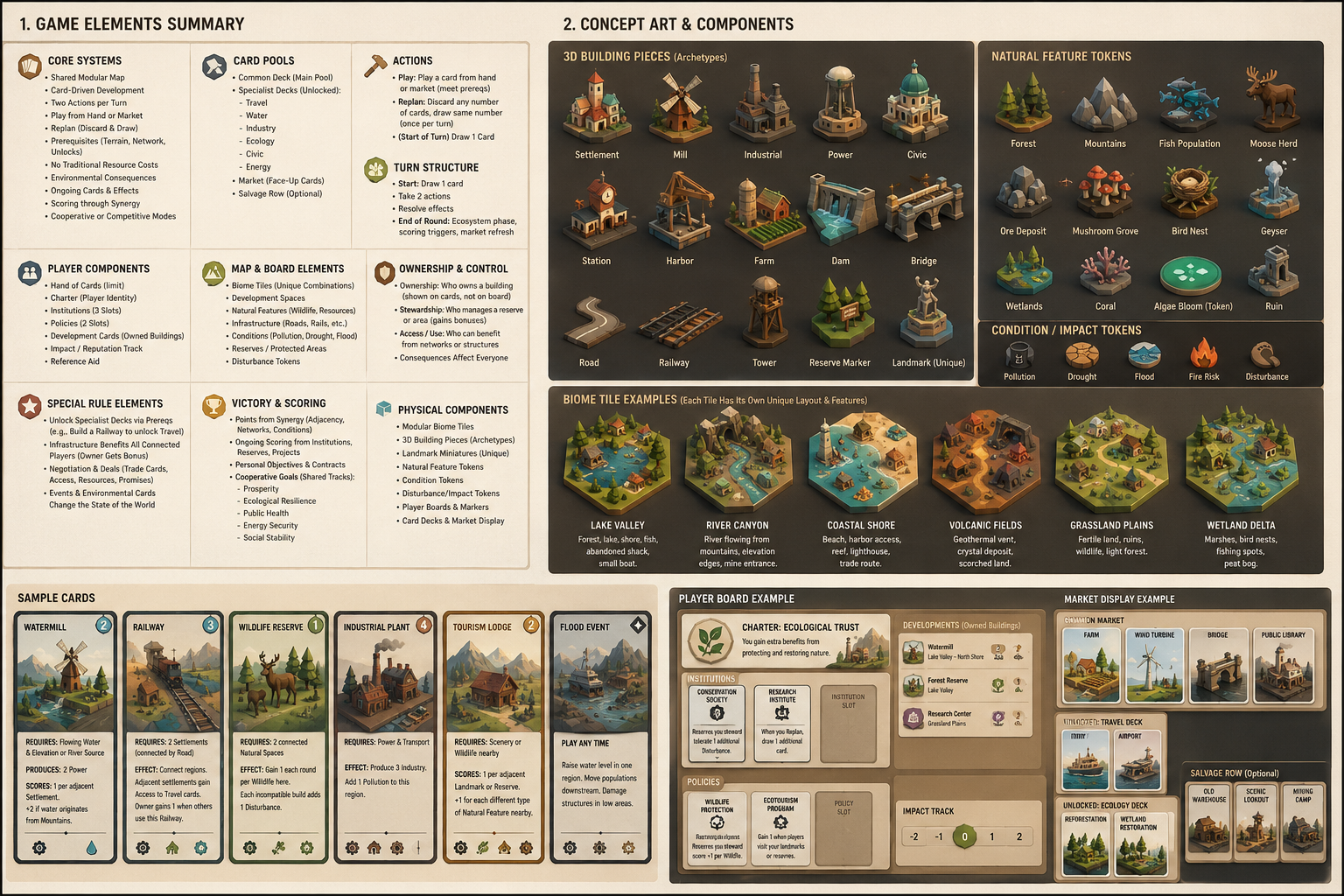
Not a small drift — a structural one. Both are coherent; they are not compatible. This needs a decision before more rules get written on top of the wrong foundation.
| Question | Board 02 says | Current rules say |
|---|---|---|
| How do you pay for things? | "No Traditional Resource Costs." You meet prerequisites — terrain, network, unlocks — and play the card. | A Nutrient economy. Income from Presence on living hexes; cards cost 1–5. |
| Where do cards come from? | Hand or a shared Market row, plus unlockable specialist decks (Travel, Water, Industry, Ecology, Civic, Energy). | Hand only, with Age-gated succession packs. |
| What do you own? | A personal tableau: Charter, 3 Institutions, 2 Policies, Developments, and an Impact/Reputation track. | No tableau. Everything lives on the shared board. |
| How do you win? | Points from synergy — adjacency, networks, conditions — plus personal objectives and five shared tracks. | Two tracks only: Biodiversity ≥ 24, Connection ≥ 16. |
| Is it co-op? | "Cooperative or Competitive Modes." | Fully cooperative; everyone wins or loses together. |
My read. Board 02 is a Euro engine-builder — closer to Ark Nova or Terraforming Mars. The current rules are a cooperative puzzle — closer to Spirit Island, which is what the original vision named. The prerequisite system in particular is elegant and worth stealing regardless: "you may build a Watermill where there is flowing water and elevation" is more thematic than "pay 3 Nutrients," and it removes a whole layer of bookkeeping.
What I would do: keep the cooperative structure and the terraform cascade, and replace the Nutrient economy with Board 02's prerequisites. That keeps your tile-laying core, drops the resource accounting the physical-first brief dislikes, and makes terraforming even more central — because terraforming is how you create the prerequisites. It needs your call, though; it is your vision, not mine.
Seven forks that are genuinely undecided. Each is written so you can form a view without reading the specs, and each carries a recommendation with its reasoning shown — a recommendation you cannot argue with is not much use.
Most of these come from a real divergence: the reference boards describe a Euro engine-builder, while the written rules describe a cooperative puzzle. Both are coherent. They are not compatible.
Every card below is rendered from its data record in the Field Guide face — no card is laid out by hand. Art is procedural: 60 composable scenes, so the deck can grow without the illustration becoming a bottleneck.
The parts work. Cards carry real data, synergy computes, the keystone cascade produces exactly the swing the theme promises, and the doom→bloom curve has a defensible shape. A region can be scored, a hazard can be resolved, and the arithmetic is explainable at the table.
The whole does not. You cannot currently play a game from Age I to Age VI, because there is no defined economy, no loss condition, and no board-level scoring target. Those are not tuning gaps — they are missing systems, and no amount of card authoring substitutes for them.
Below: what's broken, what's merely unbalanced, and what genuinely works.
Computed from the balance model, not drawn by hand. Three play qualities, to test whether the intended arc survives contact with how well people actually play.